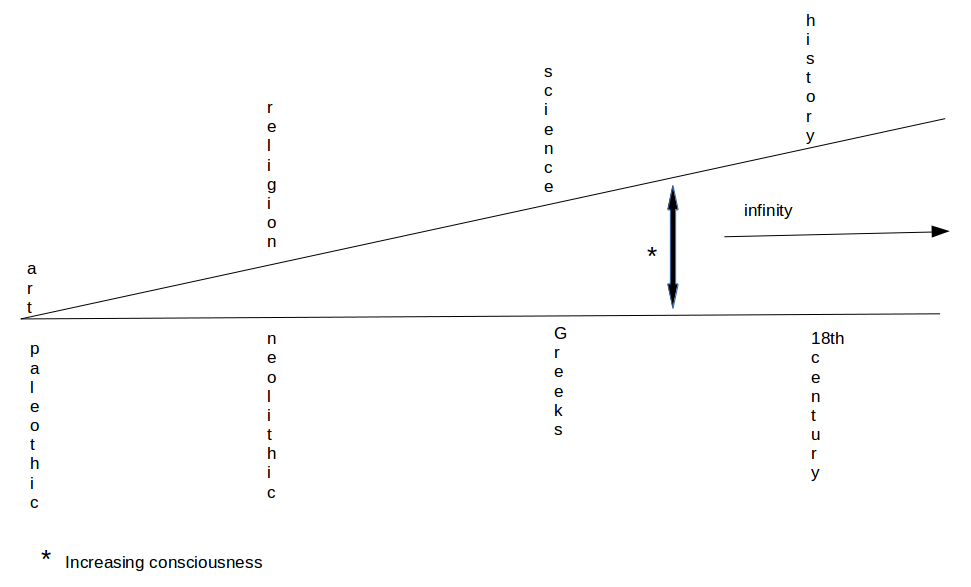
By claiming that man is moved by moral and intellectual passions, having a universal intent, and bearing upon an inexhaustible reality, [holds to a] “law of human nature” which “defies all mutation.”1
Everywhere the potential operations of a higher level are actualized by their embodiment in lower levels which [however] makes them liable to failure2
Some live in one world -in the whole – considering the manifest illusory. Some, the opposite. And some go back and forth. I guess it depends on one’s proclivities, predisposition. You can hold that metaphysical duality, relative existence is not real. But honestly, unless you are a hermit perhaps meditating in a high Himalayan cave guarded by a snow leopard, you live, more or less, in the world of the common man surrounded by things in their millions, which do not necessarily detract from the ultimate reality however considered. Whatever one is facing one can maintain commitment to the ground, the unchanging substratum from which arises the intelligibility of the whole cosmic reality. Being constrained to experience the world from a personal, limited aspect, I don’t know and can’t really know, being bound by what amounts to illusions, yet tacitly, relying on the ineffable fountain of sensory input, I extend my little self and binding it with that primal plane somehow adopt explicit knowledge, give that to the world, and then committed to hope, live the best life possible within my capacity and the grace afforded my undeserving self.
Polanyi’s work, thought, is a continuation, an enhancement of Western, ancient philosophy, of Existentialism, of Phenomenology, of the Scientific modes of knowledge, and of the modes of Religion and Art, too, and in spite of the steep learning curve previously mentioned I continue studying and making notes. The essays in “Intellect and Hope”, also mentioned in a previous post, are my primary focus here. “Intellect and Hope” is concerned with Michael Polanyi’s Tact Dimension but in covering that subject the authors bring to bear their knowledge and understanding of Western Philosophy in general. I am grateful for the references to Descartes, Rousseau, Goethe, Sartre, Kierkegaard, Kant, Husserl, Whitehead, Hegel, Saint Augustine, Aristotle, Plato, and others. These references add perspective to Polanyi’s thought and generally outline those individual author’s scholarship as they apply their study to Polanyi.
My perspective as anyone can plainly see is from the standpoint of the thought developed over millennia in the East. There are fundamental differences between this ground and that of the philosophers mentioned above, steeped as they are in the Western tradition. Polanyi’s approach to philosophy and science being a product of western thought my appreciation of the differing approaches of these systems is further enhanced. And while I am more inclined to the contributions from the East I am yet sympathetic to the obviously great efforts and commitment to truth I see in the Western tradition.
A case in point is in order here. Plato and Aristotle used craftsmanship and idea in developing their epistemology which, writes Helmut Kuhn in his essay “Personal Knowledge and the Crisis of the Philosophical Tradition” in “Intellect and Hope” is similar to Polanyi’s. Plato and Aristotle’s thought that “art partly perfects what nature is unable to finish and partly imitates nature.” This is closely akin to a favored idea I’ve adopted from the Judaic tradition, that man can be thought of as co-creator with God. Further, Kuhn writes, “[the] heuristic model is a form of man’s rational intercourse with nature rather than dominion over nature. There is no room in this view for a Cartesian ego”, Kuhn goes on. Furthermore, he says, “It is not the eye that sees or the ear that hears, but I see with my eyes and hear with my ears.” He says “The ego is the center of spontaneous activity and the principle of hierarchical order”…so, the soul is superior to the body, is in a strata above that which is materially manifest.
These are great thinkers and the benefit from studying them is incalculable. In the final analysis there will be differences but what matters more is we all share the courage to take up the path, to hopefully find out as much as is possible to mere humans, the truth of the Real, of life’s meaning and purpose. Because of the overriding importance of process in the ontological insights of the nature of the real I remain convinced that no final answer to any such queries are available but the discovery of possible approaches is. As Soren Kierkegaard suggests, God can keep his secrets but let us participate in creation by learning and understanding to the limits of our personal ability. Our path is a continuous searching out of God’s secrets.
It’s telling that Descartes’ methodological approach relies on mathematical certainty – I disagree that mathematical rigor is to be sought as a paradigm for all thought – Cartesian thought seems to divide nature; but so does ancient Western philosophy. Notably, Descartes was a mathematician and like the surgeon who sees every ailment as remedied by the scalpel, he similarly applies mathematics to every philosophical problem. We live in our bodies and so ratiocination proceeds from our bodily existence along a mentally directed path. Duality is a built in feature of this. Descartes proclaims “I think therefore I am” establishing that duality in being and in he who thinks. Instead of “I think therefore I am” it might be wiser, on reflection, to acknowledge the process, thinking, and thus eliminate the duality. The thinker thus maintains the status of being engaged in thinking, whereby the thinker, thinking, and being are streamlined into one. The three elements are not separate but make up three aspects of the phenomenon.
This, to me, properly maintains the focus of the self directed process by assimilation of man to God which Polanyi thought as the apogee of indwelling. There is indwelling of a primary order when we contemplate the stars, submicroscopic particles, cobblestones. The next higher indwelling involves biological knowledge. The tertiary is of psychological, sociological, historical knowledge. Polanyi’s scheme.
Fundamental to the understanding of human nature is the idea of a hierarchically ordered universe. “…the gradual acquisition of knowledge is an ascent of the soul rising from lower types of reality to more elevated forms … [and should be taken] as aspects of man’s assimilation to God.” These strata are an “…affirmation by which we…accept an object as existing…less sharply separated from existence itself.” Therefore, at the apogee, God is not at all separated from being while at the other end of the scale, a cobblestone, or a star are “sharply separated from existence.” This is an achievement of direct and reflective knowing. “Hence existence attributed to God has a different meaning than intended by existential judgments.”3
Polyani: “…tacit knowing’s [functional import] guides me from proximal, interiorized, particulars to the interpretation of a coherent, distal whole.” My thought: The “I think” of the cogito is (an) interiorized particular of an [illusory] coherent, distal whole. The motive of discovering a certainty, an irreducible substratum, negates the coherence of this distal whole. This follows from the nature of grasping, the desire to own the real.
Cartesian thinkers, notably Sartre, consider the “I” radically other than the real which is the given, the “out there” – This from Marjorie Grene (first essay in “Intellect and Hope”). The given is the opposite of the “I”; it is exterior, not the body. Well, true, we commonly think of perceptions as out there and the perceiver as operating from within a body. What is the truth of this? Is the subject really separate from the object? Is the world one or many? Do manifestations in the world have an independent, separate, monadic, existence?
Grene puts it thusly for Sartre: “…we are a negation, a hole in being; our manner of being is a disintegration of a unity, a flight from ourselves, and, inexorably, it is failure. And in this condition the only honest attitude is dread…” I tend to construe this as critical of, not only Sartre, but Descartes and dualism in general. I suppose Sartre would prefer we stay in our body where we belong, are not estranged, in his view, from the “out there.” We should, in other words, dread leaving our body from which there is actually “No Exit”. What if we couldn’t find our way back?
Grene recognizes this bifurcation of the real not as denial of the self but as a polarity. She states that being is to be appropriated by passion – strong desire resulting in commitment – and self-surrender which is the means of finding ourselves. The idea she points to of Goethe’s that “Das Ewig-Weibliche zieht uns hinan” – “The eternal feminine draws us upward.” expresses a sentiment close to my heart. Polanyi departs from Sartre in that to him the person is totally responsible but instead of being focused “out there” it is an inwardness. I agree. For him discovery of the unknown, ferreting out its secrets, is based on, begins with, subsidiary awareness of being in a body. Understood, indwelling for Polanyi involves deep understanding of the elements that make up subsidiary awareness. These are relied upon without necessarily being the primary focus of attention. The backdrop for such indwelling is first of all being bound by our body. But I consider the body is not really the limit of our indwelling, for it, in turn, is fixed in the world itself. The deeper one’s understanding of our subsidiary awareness of being in the world – not just our body – the more meaningful our focal awareness, the more acute the input of our organs of perception whose focal point is the usually falsely presumed exteriorized multiplicity of the world, of relative existence. In other words, it is from the standpoint of the world itself that we focus on the world itself. It is a self study, the “other” of cartesianism being illusory. To replace the “out there” with an “in here”, according to some systems of thought, makes more sense. Yet I always allow that perhaps I don’t really understand, or that changing standpoints is not easily explained. What I am attempting is to come at the issue from the standpoint that the Real, Being, is non-dual. That we perceive duality is because we take the illusion of duality as real whereas it’s a presumption. I do see that there are systems of thought, particularly science, that depend on the reality of the appearance of phenomenal reality as being real in itself in order to work. Without data there’s nothing to measure and such data is ever concerned with appearances being taken as real in themselves.
Marjorie Grene mentions self-surrender which to me is comparable to the Kierkegaardian notion of resignation. I interpret this as denoting a sort of indifference, as in Eastern thought, which should be directly proportionate to self-surrender. To truly yield involves being indifferent which means effacement of one’s self; the putting aside of ego involvement. This, in turn brings us to Polanyi’s adoption of commitment – Saint Augustine’s contribution – as a proper mode of being in a world void of our ego involvement. This Polanyian commitment is, I think, akin to faith; which is to say that not being able to appropriate certitude one gives over to faith, self-surrender, the outcome of one’s search for solutions to problems, scientific or otherwise. We only appropriate the truth by surrender to the real!
In this regard Polanyi realizes that eventually decisions must be made in our different types of endeavors. He realizes that these might not be perfect but in order to move forward one must take a risk, so, “let’s try this and see what happens” is often called for; some say when the frustration of solving a problem grows to a breaking point, “do something even if it is wrong.” Certainty is elusive even in the relative world, or impossible, given the nature of being as process. For the religious this is like saying “I leave that to the Lord.” This is an honest recognition of one’s incapacity to solve, overcome, every problem encountered; its also a recognition that abandonment of the subjective necessarily relents to a higher will. One might be committed to overcoming an obstacle, to working out a scientific theory, yet recognize the great difficulties involved. Everyone knows that discovery is aided by self-surrender, resignation to the outcome whatever it might be; passionate commitment is essential to bringing to fruition the efforts expended in a solution’s pursuit; and I would add, vulnerability. Consider reason an opening gambit which often begins with a mere “hunch,” a wondering if so-and-so is applicable. Having thus cracked open the portal we wait and perhaps are surprised when some light comes through sending us back to reason again which opens other doors revealing more light, or knowledge, if you like, of data, the stuff of phenomenal reality, the process. Back and forth, give and receive, a problem thus seemingly finds its own solution, which indeed is our hope. Keep in mind, “according to Polanyi the hallmark of genuine knowledge consists in establishing contact with reality… where knowledge has an intrinsically ontological significance: it claims to reveal reality such as it is by itself.” One puts forth an idea, which if it is a good one, mobilizes supporting ideas thus leading to the opening of avenues for continued searches. Pre-existing, tacit, notions enrich, or perhaps, disrupt, but even so clear a path forward. In this, “Truth, through commitment, becomes the basis of a temporal event without being reduced to temporality.”
Marcel Proust in his “Remembrance of things Past” writes that reality takes shape in memory alone. And Aristotle said that every kind of learning starts from pre-existing knowledge, which makes learning a kind of remembering. Reason’s cracking open the portal is the utilization of tacit knowledge and furthers the development of explicit knowledge. Without tacit knowledge explicit knowledge is impossible. Also, “perception prefigures all our knowing of things.” Hope is the vehicle on which we depend to carry us from the opening of the portal to the emergence of explicit knowing which corresponds to as complete an understanding of the manifest as is achievable. And since reason always involves multiple things it should follow that tacit as well as explicit knowledge inevitably involves multiplicities. But what if there is really only one thing? Well then, the richness of the manifold must be taken as illusory. We are playing in a sand box filled with myriads of discrete items but our concern is not with the box as a whole rather with the play of how exactly, or as exactly as possible, we can define the relations of the parts. This is working with what we are given. This is using measurement for Scientific investigation.
Edward Pol’s essay “Polanyi and the problem of Metaphysical Knowledge” points out the apparent lower and higher forms of mind. He delineates the deductive mind as rational as opposed to the intuitive and agreeing with Polanyi places a higher value on explicit knowledge. Polanyi writes that the “…human mind is at its greatest when it brings hitherto uncharted domains under its control.” Aristotle, Plato, Descartes, per Pol, all share views of mind having the two levels deductive and intuitional. So what is Polanyi driving at here? I rather think, though acceding to these classical Western views of the mind, he is elevating the role of discovery, of self-surrender in contrast to the tendency to over emphasize ratiocination. The freedom to isolate “explicit knowledge” – which I take to be scientific in nature – is enhanced when rationalism and discovery work hand in hand. Sometimes its surprising the positive outcome to be had by just letting things take their natural course. Yield.
As for metaphysics, I don’t know. Is the idea of metaphysics based on a false sense of duality? One has perceptions of the world from within a body itself rooted in the whole world. So, the world perceives itself by virtue of an apparently embodied mind utilizing the organs of perception. We see, hear, feel, etc., multiplicities of things, apparently different from, or outside, the locus of the bodily organs. But are they really? Maybe I don’t have a full grasp of the issue. Paraphrasing Edward Pol, the Real, our experience of it, is always and only partly accessible, only its appearance, filtered by our organs of perception, is accessible. Conclude that which is “really Real” is not exhausted in the manifestation; this applies equally to our body. Our minds get a snapshot of the process which instantly moves on. We do not ever get a clear picture if the picture rapidly changes. So we are left with a partial view not being able to “own” the process as it is in itself. My thought is that we are given enough to cope with reality but that given “also always hides it from us.” Pol uses Kant to somewhat define metaphysical knowledge. Kant’s idea was that such knowledge was inaccessible to reason. Fair enough. Note that personally, I think knowledge is necessarily always and only about relative being, the universe of objects, things. To say metaphysical knowledge makes no sense. Replace understanding with knowledge when considering metaphysical reality and you are a bit closer to actuality.
If one were to hold that metaphysics pertains to that which is not accessible to reason, that where reason ceases to function and intuition picks up one finds metaphysics I think they would be on the right way. I wish here to quote Pol again as it seems to clear up some confusion: “We now have to ask whether Polanyi’s doctrine is sufficient to confirm our capacity for metaphysical knowledge…In asking this we are not asking whether the doctrine purports to carry us beyond the merely phenomenal. We are asking whether it really does carry us there – that is, whether it confirms us in our right to “at least something of the domain that Kant held to be inaccessible to reason.” Regarding this note that Polanyi thinks there are degrees of being and that we can know at least some of them. “For the degree of being doctrine is logically incompatible with a distinction between the merely phenomenal on the one hand and absolute reality, being, Transcendence, or the thing-in-itself on the other. If there should be degrees of being and all the degrees should be phenomenal, it must still be true that a higher degree yields us more of being than a lower, so that the pejorative sense of phenomenal is blurred sufficiently for us not to wish to speak of the merely phenomenal. Something of being discloses itself in a phenomenon that has a higher degree of being than some other phenomenon.” Or, I’d say, than the mere appearance of the phenomenon itself. Question. What if, as some hold, there is no real distinction between phenomena and ultimate reality? Also, how can there be a something of being if being is eternal, without differentiation, infinite, boundless?
William Poteat’s essay in “Intellect and Hope” concerns the “prelingual ground of human intelligence.” He says of the “active-passive quality of [his] relation to [his] own utterances” that they are primitive and irreducible. This “…parallels Polanyi’s tacit-explicit, subsidiary-focal, proximal-distal … dichotomies which are the throw back to the ancient levels of the mind – in the Western tradition – deductive (reason), intuition dichotomies. Fair enough. But however prelingual the ground it nevertheless seems to me that language casts a dark shadow on thought such that uttering “I” think so and so might be construed to give a kind of certitude but that “I” is a word, a name, and thus a “dark shadow” obfuscating who, or what, actually thinks. My “I”, or any name at all never fully expresses that which is named. Thus the world is illusory and mythological “when the self deception of the mind is realized…all symbolism is bound to obscure what it intends to reveal.”4
My own: Language in this regard is not different from nature itself whose myriads of forms might be said to at least partially disclose ultimate reality. This striving is infinitely varied. It reveals not God but “casts shadows” thereon. Knowledge likewise. I think the ultimate reality is however ‘revealed’ when one comes to an (intuitive) understanding of this. Submitted – the greater the belief in the validity of the language or knowledge, the darker the shadow, the denser the obfuscation. Thus we should be careful that science doesn’t hide what it seeks to reveal just because we trust our measurements. Religion likewise, because we trust our faith. By reason’s application the world of sensory input is naturally transferred into the world of ideas, meaning, and purpose, by virtue of the naming process. First we notice, then name, then denote and then knowledge and understanding follow; but a caveat not to trust our name. Reason is only the opening gambit and should give way to intuition whereupon perhaps going back to reason another portal is set ajar calling on more intuition, and so on, back and forth. Important to note that Polanyi thought “science is a feature of the emergence of man and of mind in a cosmic and living process.”
As for the cogito itself Descartes might have tried “I am, therefore I think”.5 But nevertheless the cogito doesn’t, from my point of view, afford certainty at all, or meaning, or purpose. I think Descartes’ work is a patch on Plato’s idea that reason and intuition represent the mind’s dual levels, deductive and intuitional. It might be safe to say that the whole of Western philosophy is similarly a series of patches on this presumption that the world is explicable, that it is measurable and that should be the basis for our knowledge and understanding of the cosmos. Whether all our measuring is really approximate, a best guess, it still follows this program certainly bears fruit. The atom bomb, for instance, and being omnipresent on this earth using our highly developed – at least we think so – information technology, the discoveries of physics via quantum mechanics.
When I read the various works referenced here I am humbled and in awe of the prodigious commitments. These all are dedicated to finding out the truth and by a process of discovery do so with some consistency. But this is a geologically slow process requiring humility and the patience of a cobblestone. Who am I to decry their honest toil. I’m sure I don’t have the capacity or the scholarly underpinning for my critique to be taken seriously. Perhaps we should be satisfied with just a glimpse of the Real, Being. Substitute God for the Real, for Being and looking again at Ernst Cassirer: God evolves out of the impersonal, without attributes, to personal, and then back again to inexpressible, not bound by any word, back to immanence, an ineffable unknowable. Cassirer points out that “…as speech has a tendency to divide, determine and fixate, so it has also, no less strongly, a tendency to generalize…[striving] for a concept of Being that is unlimited by any particular manifestation, and therefore not expressible in any word, not called by any name.” I give you YHWH, purposely unpronounceable, without vowels. This, the “Word,” takes us to transcendence of the “Word.” Also, the skillfulness of the wise is to express with language what is inexpressible. That is attributable to Nagarjuna. Reason is required for this; the process of “if so-and-so,” then it follows, another “so-and-so.”
Also from Cassirer. The Word gives objective reality – at least that is the intention – the ground wherein subjective reality takes root. Thus begins the process of self realization whereby the subject’s seeing, knowing, understanding, culminate in merging with that from which it issued; that is the nameless presence or substratum. Yet, he says, being is not properly speaking an attribute of God, the eternal. God has no existence, other than by virtue of phenomenal beings. God has no existence, which would presume duality – only things have existence. Being and self are distinct only in expression. The transcendent is inaccessible to language and conception. (and I would add, manifestation as such) But, drawing on the work of Max Muller and Muller’s colleague, Codrington, ” …with every finite perception there is a concomitant perception, or, if that word would seem too strong, a concomitant sentiment or presentiment of the infinite; that from the very first act of touch, or hearing or sight, we are brought in contact, not only with a visible, but at the same time with an invisible universe.” That is your transcendental, your metaphysic – or as close as you’ll get. This seems to me a never spoken – to my knowledge – yet built in feature of Polanyi’s tacit dimension and those in his circle and, yes, those who preceded them in this line or mode of making sense of the deductive-intuitional levels of the mind and thus of the impedance of reason itself. Given, duality is necessary for self realization, and we should trust to Goethe’s feminine principle to bring seekers to an elevation where this can be appreciated.
Rousseau’s thought along with the others is foundational to that of Polanyi and I would bring him into this writing which will again take us to Kant and Goethe for comparison purposes.
There is no division between natural man and civilized man, ethical, moral man.6 Its a progression and stages are involved. So, 18th century thought is heading the wrong way dividing natural man from civilized. Yes, man was once more primitive, in a state of “nature”, but being reasonable and civilized are best viewed as a continuation, modification, of the primitive. It’s not as if somewhere along the way we retooled ourselves. So, in us, the first man still lives bearing the overlay of millennia of adaptations. Its like we all see the same world, but from differing aspects. This might involve various doctrines, call them paths, or approaches, which consist rather of a kind of shift of view-point, a modification of modes of thought. Thus the West meets or joins the East. Or as Desani benevolently said “if you had only one religion you would have only one view.”
Part of this overlay is the idea that faith is based on ethical or moral certainty – what there is of it – not reason. Reason comes into its own with the emergence of scientific modes and, more primitively, religious modes. In the development of our intellectual faculties comes the idea that there is no final cause for nature. Rousseau’s long walks in the forest engendered a romantic view of nature, simpler, true, than the sophisticated 18th century salon life’s. His statement that “All the subtleties of metaphysics would not lead me to doubt for a moment the immortality of my soul or a spiritual Providence; I feel it, I believe in it, I desire it, I hope for it, and will defend it to my last breath” is germane to the discussion at hand. He was committed, in the Polanyian sense, to this mode of being.
And Kant’s, this is also germane, treatise on the Failure of All Philosophic Attempts at Theodicy wherein he decries the setting up of speculative reason as God’s defender saying that transcends the limits of reason resulting in sophistry. Cassirer: “Not only have all previous attempts at theodicy failed, but it can indeed be shown that they had to fail and will always have to. For it can be shown that our reason is altogether incapable of gaining insight into the relation between the world, however well we may know it through experience, and the highest Wisdom.”
This, regarding commitment, from Goethe provides some further insight.”He only deserves his freedom and existence who daily conquers them anew.” and also, more importantly, to my approach, “[The] eternal is revealed by the transitory.” That, indeed, is a statement from the highest wisdom. It is likely as close as anyone, anywhere, anytime, will ever get to true metaphysics. So, live your life with one foot in the here and now and one in the eternal. Its the best you can do.
Some final thoughts. I find and place myself in the traditions of the East, mainly India, but also Tibet, and China, and Japan, though, of course, I was raised and live in the West, though I have visited China, Japan, Vietnam. Some think of the distance between East and West as infinite but I don’t. Its one world. The circumstances of my search for a meaningful life when I was a very young man led me away from the West towards the East where I began to take serious note of the beauty, the congruence, of Eastern spiritual culture. The authority of the seekers of wisdom taking hold in my malleable condition was a further draw. Their consensus was a source of comfort. But simultaneously I was opening doors in the Western traditions too that also bore on my nascent wonder of these matters of meaning and purpose in life. No doubt, my admittedly primitive earliest exposure to such things, via the religious administrations of dogmatic Pentecostal doctrine, were at minimum, precursors to this latter spiritual predisposition. As mentioned above, the various doctrines encountered, call them paths or approaches, …”consist rather of a kind of re-description, a shift of view-point, a modification of modes of thought where we all see the same world but from differing aspects.”7 The place of intuitive insight began dawning on me; I became aware of the task of becoming a more skillful perceiver. One must learn, somehow, to see with one’s eyes, to hear with one’s ears. Faith, belief, took on new form along with beauty, love, knowledge, understanding, wisdom, and freedom. I still am, with geologic slowness, going through a paradigm shift from my earliest religious experience. The role of my teachers, benefactors, can’t be over stated. I realize how primitive man remains. Now I find I have a vision of reality which no criteria of verifiability or testability apply. I do not see, I refuse to see, that the East rivals the West or that Christianity rivals Buddhism or that ratiocination rivals intuition.
The aspects of Ultimate Reality represented by the spiritual pursuits of mankind are perhaps without number. None are completely false; none completely true. Nothing manifested, nothing in relative existence, exhausts the potentiality of that which endlessly issues forth into the transitory. “The eternal is revealed by the transitory.”
There is a divine mother, a Devi, Devi Durga. Images of her, crowned with a halo of blinding light, show faces of unsurpassed beauty as well as unsurpassed cruelty. She displays many arms, faculties, holding many different things, Destructive weapons, things of beneficence, a flower – a mountain lily. These are not seen by all. Her enemies know the weapons; her supplicants the flower, and whose appeal is to the sky “sweet sky, let kindly clouds shower pearls and jasmines on holy Durga.”8 To them the cruel face is not seen and the weapons held in abeyance.
How reality is approached largely determines the revelation of an aspect, a standpoint; we make our own point of view by our personal commitment, our strong intention. The artist’s view is thus somewhat different from the religious and likewise for the scientific and the philosophical. None are exactly alike. Neither are they irreconcilably different. A wise person sees them as complementary. A wise man understands that for every person the ultimate reality is a little different; this is a feature mistaken by some as a bug. My personal experience as a mere child of the Pentecostal view of reality is still here underpinning my continued search in my dotage for life’s secrets. Now I live only for those rare moments when I am vouchsafed a glimpse of the divine’s closely held intimate truths.
- Carl J. Friedrich’s essay “Man, The Measure: Personal Knowledge and the Quest for Natural Law” in “Intellect and Hope” ↩︎
- Carl J. Friedrich’s essay “Man, The Measure: Personal Knowledge and the Quest for Natural Law” in “Intellect and Hope” ↩︎
- Helmut Kuhn’s essay “Personal Knowledge and the Crisis of the Philosophical Tradition” in “Intellect and Hope” ↩︎
- Ernst Cassirer, Language and Myth, translated by Susanne K. Langer, Dover Publications, New York 1946, 1953 ↩︎
- Ego sum ergo cogito “appears in some of Descartes’ works, such as his posthumously published “The Search for Truth by Natural Light,” where he expressed the insight as “dubito, ergo sum, vel, quod idem est, cogito, ergo sum” (“I doubt, therefore I am — or what is the same — I think, therefore I am”)” – from internet search ↩︎
- Ernst Cassirer, Rousseau, Kant, and Goethe, Harper Torchbook, 1963 ↩︎
- C.B. Daly’s essay “Polanyi and Wittengenstein” in “Intellect and Hope” ↩︎
- G.V. Desani, “Hali and Collected Stories” McPherson & Company, 1991, 92, 93, 94, 95, 96 – the Preface ↩︎