The Tacit Dimension Continued

By claiming that man is moved by moral and intellectual passions, having a universal intent, and bearing upon an inexhaustible reality, [holds to a] “law of human nature” which “defies all mutation.”1

Everywhere the potential operations of a higher level are actualized by their embodiment in lower levels which [however] makes them liable to failure2

Some live in one world -in the whole – considering the manifest illusory. Some, the opposite. And some go back and forth. I guess it depends on one’s proclivities, predisposition. You can hold that metaphysical duality, relative existence is not real. But honestly, unless you are a hermit perhaps meditating in a high Himalayan cave guarded by a snow leopard, you live, more or less, in the world of the common man surrounded by things in their millions, which do not necessarily detract from the ultimate reality however considered. Whatever one is facing one can maintain commitment to the ground, the unchanging substratum from which arises the intelligibility of the whole cosmic reality. Being constrained to experience the world from a personal, limited aspect, I don’t know and can’t really know, being bound by what amounts to illusions, yet tacitly, relying on the ineffable fountain of sensory input, I extend my little self and binding it with that primal plane somehow adopt explicit knowledge, give that to the world, and then committed to hope, live the best life possible within my capacity and the grace afforded my undeserving self.

Polanyi’s work, thought, is a continuation, an enhancement of Western, ancient philosophy, of Existentialism, of Phenomenology, of the Scientific modes of knowledge, and of the modes of Religion and Art, too, and in spite of the steep learning curve previously mentioned I continue studying and making notes. The essays in “Intellect and Hope”, also mentioned in a previous post, are my primary focus here. “Intellect and Hope” is concerned with Michael Polanyi’s Tact Dimension but in covering that subject the authors bring to bear their knowledge and understanding of Western Philosophy in general. I am grateful for the references to Descartes, Rousseau, Goethe, Sartre, Kierkegaard, Kant, Husserl, Whitehead, Hegel, Saint Augustine, Aristotle, Plato, and others. These references add perspective to Polanyi’s thought and generally outline those individual author’s scholarship as they apply their study to Polanyi.

My perspective as anyone can plainly see is from the standpoint of the thought developed over millennia in the East. There are fundamental differences between this ground and that of the philosophers mentioned above, steeped as they are in the Western tradition. Polanyi’s approach to philosophy and science being a product of western thought my appreciation of the differing approaches of these systems is further enhanced. And while I am more inclined to the contributions from the East I am yet sympathetic to the obviously great efforts and commitment to truth I see in the Western tradition.

A case in point is in order here. Plato and Aristotle used  craftsmanship and idea in developing their epistemology which, writes Helmut Kuhn in his essay “Personal Knowledge and the Crisis of the Philosophical Tradition” in “Intellect and Hope” is similar to Polanyi’s. Plato and Aristotle’s thought that “art partly perfects what nature is unable to finish and partly imitates nature.” This is closely akin to a favored idea I’ve adopted from the Judaic tradition, that man can be thought of as co-creator with God. Further, Kuhn writes, “[the] heuristic model is a form of man’s rational intercourse with nature rather than dominion over nature. There is no room in this view for a Cartesian ego”, Kuhn goes on. Furthermore, he says, “It is not the eye that sees or the ear that hears, but I see with my eyes and hear with my ears.” He says “The ego is the center of spontaneous activity and the principle of hierarchical order”…so, the soul is superior to the body, is in a strata above that which is materially manifest.

These are great thinkers and the benefit from studying them is incalculable. In the final analysis there will be differences but what matters more is we all share the courage to take up the path, to hopefully find out as much as is possible to mere humans, the truth of the Real, of life’s meaning and purpose. Because of the overriding importance of process in the ontological insights of the nature of the real I remain convinced that no final answer to any such queries are available but the discovery of possible approaches is. As Soren Kierkegaard suggests, God can keep his secrets but  let us participate in creation by learning and understanding to the limits of our personal ability. Our path is a continuous searching out of God’s secrets.

It’s telling that Descartes’ methodological approach relies on mathematical certainty – I disagree that mathematical rigor is to be sought as a paradigm for all thought – Cartesian thought seems to divide nature; but so does ancient Western philosophy. Notably, Descartes was a mathematician and like the surgeon who sees every ailment as remedied by the scalpel, he similarly applies mathematics to every philosophical problem. We live in our bodies and so ratiocination proceeds from our bodily existence along a mentally directed path. Duality is a built in feature of this. Descartes proclaims “I think therefore I am” establishing that duality in being and in he who thinks. Instead of “I think therefore I am” it might be wiser, on reflection, to acknowledge the process, thinking, and thus eliminate the duality. The thinker thus maintains the status of being engaged in thinking, whereby the thinker, thinking, and being are streamlined into one. The three elements are not separate but make up three aspects of the phenomenon.

This, to me, properly maintains the focus of the self directed process by assimilation of man to God which Polanyi thought as the apogee of indwelling. There is indwelling of a primary order when we contemplate the stars, submicroscopic particles, cobblestones. The next higher indwelling involves biological knowledge. The tertiary is of psychological, sociological, historical knowledge. Polanyi’s scheme.

Fundamental to the understanding of human nature is the idea of a hierarchically ordered universe. “…the gradual acquisition of knowledge is an ascent of the soul rising from lower types of reality to more elevated forms … [and should be taken] as aspects of man’s assimilation to God.” These strata are an “…affirmation by which we…accept an object as existing…less sharply separated from existence itself.” Therefore, at the apogee, God is not at all separated from being while at the other end of the scale, a cobblestone, or a star are “sharply separated from existence.” This is an achievement of direct and reflective knowing. “Hence existence attributed to God has a different meaning than intended by existential judgments.”3

Polyani: “…tacit knowing’s [functional import] guides me from proximal, interiorized, particulars to the interpretation of a coherent, distal whole.” My thought: The “I think” of the cogito is (an) interiorized particular of an [illusory] coherent, distal whole. The motive of discovering a certainty, an irreducible substratum, negates the coherence of this distal whole. This follows from the nature of grasping, the desire to own the real.

Cartesian thinkers, notably Sartre, consider the “I” radically other than the real which is the given, the “out there” – This from  Marjorie Grene (first essay in “Intellect and Hope”). The given is the opposite of the “I”; it is exterior, not the body. Well, true, we commonly think of perceptions as out there and the perceiver as operating from within a body. What is the truth of this? Is the subject really separate from the object? Is the world one or many? Do manifestations in the world have an independent, separate, monadic, existence?

Grene puts it thusly for Sartre: “…we are a negation, a hole in being; our manner of being is a disintegration of a unity, a flight from ourselves, and, inexorably, it is failure. And in this condition the only honest attitude is dread…” I tend to construe this as critical of, not only Sartre, but Descartes and dualism in general. I suppose Sartre would prefer we stay in our body where we belong, are not estranged, in his view, from the “out there.” We should, in other words, dread leaving our body from which there is actually “No Exit”. What if we couldn’t find our way back?

Grene recognizes this bifurcation of the real not as denial of the self but as a polarity. She states that being is to be appropriated by passion – strong desire resulting in commitment – and self-surrender which is the means of finding ourselves. The idea she points to of Goethe’s that “Das Ewig-Weibliche zieht uns hinan” – “The eternal feminine draws us upward.” expresses a sentiment close to my heart. Polanyi departs from Sartre in that to him the person is totally responsible but instead of being focused “out there” it is an inwardness. I agree. For him discovery of the unknown, ferreting out its secrets, is based on, begins with, subsidiary awareness of being in a body. Understood, indwelling for Polanyi involves deep understanding of the elements that make up subsidiary awareness. These are relied upon without necessarily being the primary focus of attention. The backdrop for such indwelling is first of all being bound by our body. But I consider the body is not really the limit of our indwelling, for it, in turn, is fixed in the world itself. The deeper one’s understanding of our subsidiary awareness of being in the world – not just our body – the more meaningful our focal awareness, the more acute the input of our organs of perception whose focal point is the usually falsely presumed exteriorized multiplicity of the world, of relative existence. In other words, it is from the standpoint of the world itself that we focus on the world itself. It is a self study, the “other” of cartesianism being illusory. To replace the “out there” with an “in here”, according to some systems of thought, makes more sense. Yet I always allow that perhaps I don’t really understand, or that changing standpoints is not easily explained. What I am attempting is to come at the issue from the standpoint that the Real, Being, is non-dual. That we perceive duality is because we take the illusion of duality as real whereas it’s a presumption. I do see that there are systems of thought, particularly science, that depend on the reality of the appearance of phenomenal reality as being real in itself in order to work. Without data there’s nothing to measure and such data is ever concerned with appearances being taken as real in themselves.

Marjorie Grene mentions self-surrender which to me is comparable to the Kierkegaardian notion of resignation. I interpret this as denoting a sort of indifference, as in Eastern thought, which should be directly proportionate to self-surrender. To truly yield involves being indifferent which means effacement of one’s self; the putting aside of ego involvement. This, in turn  brings us to Polanyi’s adoption of commitment – Saint Augustine’s contribution – as a proper mode of being in a world void of our ego involvement. This Polanyian commitment is, I think, akin to faith; which is to say that not being able to appropriate certitude one gives over to faith, self-surrender, the outcome of one’s search for solutions to problems, scientific or otherwise. We only appropriate the truth by surrender to the real!

In this regard Polanyi realizes that eventually decisions must be made in our different types of endeavors. He realizes that these might not be perfect but in order to move forward one must take a risk, so, “let’s try this and see what happens” is often called for; some say when the frustration of solving a problem grows to a breaking point, “do something even if it is wrong.” Certainty is elusive even in the relative world, or impossible, given the nature of being as process. For the religious this is like saying “I leave that to the Lord.” This is an honest recognition of one’s incapacity to solve, overcome, every problem encountered; its also a recognition that abandonment of the subjective necessarily relents to a higher will. One might be committed to overcoming an obstacle, to working out a scientific theory, yet recognize the great difficulties involved. Everyone knows that discovery is aided by self-surrender, resignation to the outcome whatever it might be; passionate commitment is essential to bringing to fruition the efforts expended in a solution’s pursuit; and I would add, vulnerability. Consider reason an opening gambit which often begins with a mere “hunch,” a wondering if so-and-so is applicable. Having thus cracked open the portal we wait and perhaps are surprised when some light comes through sending us back to reason again which opens other doors revealing more light, or knowledge, if you like, of data, the stuff of phenomenal reality, the process. Back and forth, give and receive, a problem thus seemingly finds its own solution, which indeed is our hope.  Keep in mind, “according to Polanyi the hallmark of genuine knowledge consists in establishing contact with reality… where knowledge has an intrinsically ontological significance: it claims to reveal reality such as it is by itself.” One puts forth an idea, which if it is a good one, mobilizes supporting ideas thus leading to the opening of avenues for continued searches. Pre-existing, tacit, notions enrich, or perhaps, disrupt, but even so clear a path forward. In this, “Truth, through commitment, becomes the basis of a temporal event without being reduced to temporality.”

Marcel Proust in his “Remembrance of things Past” writes that reality takes shape in memory alone. And Aristotle said that every kind of learning starts from pre-existing knowledge, which makes learning a kind of remembering. Reason’s cracking open the portal is the utilization of tacit knowledge and furthers the development of explicit knowledge. Without tacit knowledge explicit knowledge is impossible. Also, “perception prefigures all our knowing of things.” Hope is the vehicle on which we depend to carry us from the opening of the portal to the emergence of explicit knowing which corresponds to as complete an understanding of the manifest as is achievable. And since reason always involves multiple things it should follow that tacit as well as explicit knowledge inevitably involves multiplicities. But what if there is really only one thing? Well then, the richness of the manifold must be taken as illusory. We are playing in a sand box filled with myriads of discrete items but our concern is not with the box as a whole rather with the play of how exactly, or as exactly as possible, we can define the relations of the parts. This is working with what we are given. This is using measurement for Scientific investigation.

Edward Pol’s essay “Polanyi and the problem of Metaphysical Knowledge” points out the apparent lower and higher forms of mind. He delineates the deductive mind as rational as opposed to the intuitive and agreeing with Polanyi places a higher value on explicit knowledge. Polanyi writes that the “…human mind is at its greatest when it brings hitherto uncharted domains under its control.” Aristotle, Plato, Descartes, per Pol, all share views of mind having the two levels deductive and intuitional. So what is Polanyi driving at here? I rather think, though acceding to these classical Western views of the mind, he is elevating the role of discovery, of self-surrender in contrast to the tendency to over emphasize ratiocination. The freedom to isolate “explicit knowledge” – which I take to be scientific in nature – is enhanced when rationalism and discovery work hand in hand. Sometimes its surprising the positive outcome to be had by just letting things take their natural course. Yield.

As for metaphysics, I don’t know. Is the idea of metaphysics based on a false sense of duality? One has perceptions of the world from within a body itself rooted in the whole world. So, the world perceives itself by virtue of an apparently embodied mind utilizing the organs of perception. We see, hear, feel, etc., multiplicities of things, apparently different from, or outside, the locus of the bodily organs. But are they really? Maybe I don’t have a full grasp of the issue. Paraphrasing Edward Pol, the Real, our experience of it, is always and only partly accessible, only its appearance, filtered by our organs of perception, is accessible. Conclude that which is “really Real” is not exhausted in the manifestation; this applies equally to our body. Our minds get  a snapshot of the process which instantly moves on. We do not ever get a clear picture if the picture rapidly changes. So we are left with a partial view not being able to “own” the process as it is in itself. My thought is that we are given enough to cope with reality but that given “also always hides it from us.” Pol uses Kant to somewhat define metaphysical knowledge. Kant’s idea was that such knowledge was inaccessible to reason. Fair enough. Note that personally, I think knowledge is necessarily always and only about relative being, the universe of objects, things. To say metaphysical knowledge makes no sense. Replace understanding with knowledge when considering metaphysical reality and you are a bit closer to actuality.

If one were to hold that metaphysics pertains to that which is not accessible to reason, that where reason ceases to function and intuition picks up one finds metaphysics I think they would be on the right way. I wish here to quote Pol again as it seems to clear up some confusion: “We now have to ask whether Polanyi’s doctrine is sufficient to confirm our capacity for metaphysical knowledge…In asking this we are not asking whether the doctrine purports to carry us beyond the merely phenomenal. We are asking whether it really does carry us there – that is, whether it confirms us in our right to “at least something of the domain that Kant held to be inaccessible to reason.” Regarding this note that Polanyi thinks there are degrees of being and that we can know at least some of them. “For the degree of being doctrine is logically incompatible with a distinction between the merely phenomenal on the one hand and absolute reality, being, Transcendence, or the thing-in-itself on the other. If there should be degrees of being and all the degrees should be phenomenal, it must still be true that a higher degree yields us more of being than a lower, so that the pejorative sense of phenomenal is blurred sufficiently for us not to wish to speak of the merely phenomenal. Something of being discloses itself in a phenomenon that has a higher degree of being than some other phenomenon.” Or, I’d say, than the mere appearance of the phenomenon itself. Question. What if, as some hold, there is no real distinction between phenomena and ultimate reality? Also, how can there be a something of being if being is eternal, without differentiation, infinite, boundless?

William Poteat’s essay in “Intellect and Hope” concerns the “prelingual ground of human intelligence.” He says of the “active-passive quality of [his] relation to [his] own utterances” that they are primitive and irreducible. This “…parallels Polanyi’s tacit-explicit, subsidiary-focal, proximal-distal  … dichotomies which are the throw back to the ancient levels of the mind – in the Western tradition – deductive (reason), intuition dichotomies. Fair enough. But however prelingual the ground it nevertheless seems to me that language casts a dark shadow on thought such that uttering “I” think so and so might be construed to give a kind of certitude but that “I” is a word, a name, and thus a “dark shadow” obfuscating who, or what, actually thinks. My “I”, or any name at all never fully expresses that which is named. Thus the world is illusory and mythological “when the self deception of the mind is realized…all symbolism is bound to obscure what it intends to reveal.”4

My own: Language in this regard is not different from nature itself whose myriads of forms might be said to at least partially disclose ultimate reality. This striving is infinitely varied. It reveals not God but “casts shadows” thereon. Knowledge likewise. I think the ultimate reality is however ‘revealed’ when one comes to an (intuitive) understanding of this. Submitted – the greater the belief in the validity of the language or knowledge, the darker the shadow, the denser the obfuscation. Thus we should be careful that science doesn’t hide what it seeks to reveal just because we trust our measurements. Religion likewise, because we trust our faith. By reason’s application the world of sensory input is naturally transferred into the world of ideas, meaning, and purpose, by virtue of the naming process. First we notice, then name, then denote and then knowledge and understanding follow; but a caveat not to trust our name. Reason is only the opening gambit and should give way to intuition whereupon perhaps going back to reason another portal is set ajar calling on more intuition, and so on, back and forth. Important to note that Polanyi thought “science is a feature of the emergence of man and of mind in a cosmic and living process.”

As for the cogito itself Descartes might have tried “I am, therefore I think”.5 But nevertheless the cogito doesn’t, from my point of view, afford certainty at all, or meaning, or purpose. I think Descartes’ work is a patch on Plato’s idea that reason and intuition represent the mind’s dual levels, deductive and intuitional. It might be safe to say that the whole of Western philosophy is similarly a series of patches on this presumption that the world is explicable, that it is measurable and that should be the basis for our knowledge and understanding of the cosmos. Whether all our measuring is really approximate, a best guess, it still follows this program certainly bears fruit. The atom bomb, for instance, and being omnipresent on this earth using our highly developed – at least we think so – information technology, the discoveries of physics via quantum mechanics.

When I read the various works referenced here I am humbled and in awe of the prodigious commitments. These all are dedicated to finding out the truth and by a process of discovery do so with some consistency. But this is a geologically slow process requiring humility and the patience of a cobblestone. Who am I to decry their honest toil. I’m sure I don’t have the capacity or the scholarly underpinning for my critique to be taken seriously. Perhaps we should be satisfied with just a glimpse of the Real, Being. Substitute God for the Real, for Being and looking again at Ernst Cassirer: God evolves out of the impersonal, without attributes, to personal, and then back again to inexpressible, not bound by any word, back to immanence, an ineffable unknowable. Cassirer points out that “…as speech has a tendency to divide, determine and fixate, so it has also, no less strongly, a tendency to generalize…[striving] for a concept of Being that is unlimited by any particular manifestation, and therefore not expressible in any word, not called by any name.” I give you YHWH, purposely unpronounceable, without vowels. This, the “Word,” takes us to transcendence of the “Word.” Also, the skillfulness of the wise is to express with language what is inexpressible. That is attributable to Nagarjuna. Reason is required for this; the process of “if so-and-so,” then it follows, another “so-and-so.”

Also from Cassirer. The Word gives objective reality – at least that is the intention – the ground wherein subjective reality takes root. Thus begins the process of self realization whereby the subject’s seeing, knowing, understanding, culminate in merging with that from which it issued; that is the nameless presence or substratum. Yet, he says, being is not properly speaking an attribute of God, the eternal. God has no existence, other than by virtue of phenomenal beings. God has no existence, which would presume duality – only things have existence.  Being and self are distinct only in expression. The transcendent is inaccessible to language and conception. (and I would add, manifestation as such) But, drawing on the work of Max Muller and Muller’s  colleague, Codrington, ” …with every finite perception there is a concomitant perception, or, if that word would seem too strong, a concomitant sentiment or presentiment of the infinite; that from the very first act of touch, or hearing or sight, we are brought in contact, not only with a visible, but at the same time with an invisible universe.” That is your transcendental, your metaphysic – or as close as you’ll get. This seems to me a never spoken – to my knowledge – yet built in feature of Polanyi’s tacit dimension and those in his circle and, yes, those who preceded them in this line or mode of making sense of the deductive-intuitional levels of the mind and thus of the impedance of reason itself. Given, duality is necessary for self realization, and we should trust to Goethe’s feminine principle to bring seekers to an elevation where this can be appreciated.

Rousseau’s thought along with the others is foundational to that of Polanyi and I would bring him into this writing which will again take us to Kant and Goethe for comparison purposes.

There is no division between natural man and civilized man, ethical, moral man.6 Its a progression and stages are involved. So, 18th century thought is heading the wrong way dividing natural man from civilized. Yes, man was once more primitive, in a state of “nature”, but being reasonable and civilized are best viewed as a continuation, modification, of the primitive. It’s not as if somewhere along the way we retooled ourselves. So, in us, the first man still lives bearing the overlay of millennia of adaptations. Its like we all see the same world, but from differing aspects. This might involve various doctrines, call them paths, or approaches, which consist rather of a kind of shift of view-point, a modification of modes of thought. Thus the West meets or joins the East. Or as Desani benevolently said “if you had only one religion you would have only one view.”

Part of this overlay is the idea that faith is based on ethical or moral certainty – what there is of it – not reason. Reason comes into its own with the emergence of scientific modes and, more primitively, religious modes. In the development of our intellectual faculties comes the idea that there is no final cause for nature. Rousseau’s long walks in the forest engendered a romantic view of nature, simpler, true, than the sophisticated 18th century salon life’s. His statement that “All the subtleties of metaphysics would not lead me to doubt for a moment the immortality of my soul or a spiritual Providence; I feel it, I believe in it, I desire it, I hope for it, and will defend it to my last breath” is germane to the discussion at hand. He was committed, in the Polanyian sense, to this mode of being.

And Kant’s,  this is also germane, treatise on the Failure of All Philosophic Attempts at Theodicy wherein he decries the setting up of speculative reason as God’s defender saying that transcends the limits of reason resulting in sophistry. Cassirer: “Not only have all previous attempts at theodicy failed, but it can indeed be shown that they had to fail and will always have to. For it can be shown that our reason is altogether incapable of gaining insight into the relation between the world, however well we may know it through experience, and the highest Wisdom.”

This, regarding commitment, from Goethe provides some further insight.”He only deserves his freedom and existence who daily conquers them anew.” and also, more importantly, to my approach, “[The] eternal is revealed by the transitory.” That, indeed, is a statement from the highest wisdom. It is likely as close as anyone, anywhere, anytime, will ever get to true metaphysics. So, live your life with one foot in the here and now and one in the eternal. Its the best you can do.

Some final thoughts. I find and place myself in the traditions of the East, mainly India, but also Tibet, and China, and Japan, though, of course, I was raised and live in the West, though I have visited China, Japan, Vietnam. Some think of the distance between East and West as infinite but I don’t. Its one world. The circumstances of my search for a meaningful life when I was a very young man led me away from the West towards the East where I began to take serious note of the beauty, the congruence, of Eastern spiritual culture. The authority of the seekers of wisdom taking hold in my malleable condition was a further draw. Their consensus was a source of comfort. But simultaneously I was opening doors in the Western traditions too that also bore on my nascent wonder of these matters of meaning and purpose in life. No doubt, my admittedly primitive earliest exposure to such things, via the religious administrations of dogmatic Pentecostal doctrine, were at minimum, precursors to this latter spiritual predisposition. As mentioned above, the various doctrines encountered, call them paths or approaches, …”consist rather of a kind of re-description, a shift of view-point, a modification of modes of thought where we all see the same world but from differing aspects.”7 The place of intuitive insight began dawning on me; I became aware of the task of becoming a more skillful perceiver. One must learn, somehow, to see with one’s eyes, to hear with one’s ears. Faith, belief, took on new form along with beauty, love, knowledge, understanding, wisdom, and freedom. I still am, with geologic slowness, going through a paradigm shift from my earliest religious experience. The role of my teachers, benefactors, can’t be over stated. I realize how primitive man remains. Now I find I have a vision of reality which no criteria of verifiability or testability apply. I do not see, I refuse to see, that the East rivals the West or that Christianity rivals Buddhism or that ratiocination rivals intuition.

The aspects of Ultimate Reality represented by the spiritual pursuits of mankind are perhaps without number. None are completely false; none completely true. Nothing manifested, nothing in relative existence, exhausts the potentiality of that which endlessly issues forth into the transitory. “The eternal is revealed by the transitory.”

There is a divine mother, a Devi, Devi Durga. Images of her, crowned with a halo of blinding light, show faces of unsurpassed beauty as well as unsurpassed cruelty. She displays many arms, faculties, holding many different things, Destructive weapons, things of beneficence, a flower – a mountain lily. These are not seen by all. Her enemies know the weapons; her supplicants the flower, and whose appeal is to the sky “sweet sky, let kindly clouds shower pearls and jasmines on holy Durga.”8 To them the cruel face is not seen and the weapons held in abeyance.

How reality is approached largely determines the revelation of an aspect, a standpoint; we make our own point of view by our personal commitment, our strong intention. The artist’s view is thus somewhat different from the religious and likewise for the scientific and the philosophical. None are exactly alike. Neither are they irreconcilably different. A wise person sees them as complementary. A wise man understands that for every person the ultimate reality is a little different; this is a feature mistaken by some as a bug. My personal experience as a mere child of the Pentecostal view of reality is still here underpinning my continued search in my dotage for life’s secrets. Now I live only for those rare moments when I am vouchsafed a glimpse of the divine’s closely held intimate truths.

  1. Carl J. Friedrich’s essay “Man, The Measure: Personal Knowledge and the Quest for Natural Law” in “Intellect and Hope” ↩︎
  2. Carl J. Friedrich’s essay “Man, The Measure: Personal Knowledge and the Quest for Natural Law” in “Intellect and Hope” ↩︎
  3. Helmut Kuhn’s essay “Personal Knowledge and the Crisis of the Philosophical Tradition” in “Intellect and Hope” ↩︎
  4. Ernst Cassirer, Language and Myth, translated by Susanne K. Langer, Dover Publications, New York 1946, 1953 ↩︎
  5. Ego sum ergo cogito “appears in some of Descartes’ works, such as his posthumously published “The Search for Truth by Natural Light,” where he expressed the insight as “dubito, ergo sum, vel, quod idem est, cogito, ergo sum” (“I doubt, therefore I am — or what is the same — I think, therefore I am”)” – from internet search ↩︎
  6. Ernst Cassirer, Rousseau, Kant, and Goethe, Harper Torchbook, 1963 ↩︎
  7. C.B. Daly’s essay “Polanyi and Wittengenstein” in “Intellect and Hope” ↩︎
  8. G.V. Desani, “Hali and Collected Stories” McPherson & Company, 1991, 92, 93, 94, 95, 96 – the Preface ↩︎
Global Capitalism, the Age of Reason, and the Primitive

Beauty is in the object, and it is in beauty that we see through the factual reflection of reality into Being itself.                                                                          Plato

If the doors of perception were cleansed everything would appear as it is — infinite. We’re prisoners of our senses — imprisoned behind the five doors of perception. We can’t see through any others.  William Blake

Those are old ideas, especially Plato (fifth century BC). William Blake lived in the 18th century.

Soren Kierkegaard, much more modern, lived in the 19th century. I keep going back to him, mainly, in order to gain some understanding as to the evolution of human culture. Christianity has played a major, world wide, role and Kierkegaard is known to have been a Christian though he certainly wasn’t your garden variety “Bible thumper”, though he was a minister, stood in th pulpit as such. I can imagine hearing one of his sermons. One wonders whether his philosophical ideas made it into same.

Existential mass, he thought, was the “medium” of architecture and as such was the farthest removed from language. He thought it was the most abstract medium. By this he meant language is the most concrete medium. By medium he meant these were modes of expression, of course. The most abstract “idea”, he thought, was the “sensuous genius” saying it is solely expressible in music because it is music alone that can express an energy, a storm, impatience, passion. And, it exists not in a moment, but in a succession of moments, moving always in an immediacy.

Kierkegaard believed that man’s evolution had somehow gone astray. That is the problem he wrestles with. The idea of concrete versus abstract modes of expression are intended to provide a basis for addressing this issue. He came to be convinced that Christianity through suppression of sensuousness has done the opposite. Now, sensuousness is excluded by Christianity because it is deemed contrary to spirit. This, then, becomes rather the affirmation of sensuousness as a principle power of Reality. This, of course, is not what was intended. But that is what happened. Now, we have a forbidden fruit.

So, to the extent we are bound by Christian ideals; to the extent Christianity has affected all subsequent modes of human behavior this corruption has persisted – in one form or another.

Now, this writer has a quite different view of the religion. While I hold to Kierkegaard’s ideas here there are other ways of understanding the religion if one considers even older religious ideas and possible meaning. Christianity is not, was not, a monolith. Its precursors, its reason for being in the first place, for some, give a completely different outlook on what “else” is going on here. Question is, which meaning survives and has the biggest impact on culture.

The Christian view, and this is certainly not from an esoteric tradition, is that homo sapiens have “dominion over the Earth”. The ideas of Kierkegaard were not those promoted by the church elders, of his or earlier times. Christianity was largely a political movement; its precepts were promoted in order to enhance the power of those who considered themselves as at the top layers of society. So, of course, they chose what to teach, what not to teach with that in mind. They thus corrupted the true meaning of the story of Jesus for their own corrupt purposes.

Dominion over the earth. Now, the Age of Reason, the Industrial Revolution wouldn’t have had the same impact on culture were it not for this underlying notion of man owning the earth. This ego centered movement continues to this day and appears to increasingly influence man’s life, the environment in which he operates. There’s been no abatement of this power we have arrogated to ourselves. Even those who struggle against global capitalism with its sole focus of exploiting people, ever expanding markets, consumerism run rampant, share the same ego-centrism as those who laid down the original bounds of propriety, rules of society.

One ring to bind them all, indeed. The machine only gets stronger. Its hold on us deepens ever more. It scoffs at the pale efforts of the environmentalist missionaries sent out to stem the tide that threatens to engulf every iota of life here and beyond.

Man not only worships the machine but is subsumed by it, is an extension of it happily making true in an interesting way the ancient Hindu precept that one who seeks God finds him in the same form in when he is sought. Like the early Christians we create the God that serves our desires best. For us, now, it is the machine “Hive”.

What is this mystery? Perhaps the alternate lesson tends along the lines of the only way to find the True God is to yield, not be a seeker at all. So mere meek reverence is the best way? One should simply wait (on the Lord). We’d do well to recall another Christian tenet, the forgotten one? “The meek shall inherit the earth.”

For mechanistic man steeped in the auto-phagia of global capitalism, consumerism, this is almost impossible but for the primitive it is the most natural thing in the world because he is close to, one with, nature. The primitive doesn’t own the world but belongs to it. So, the more “progress”, always increasing technological advances, the farther man is from his true self. Our artificiality increases with our absorption into consumerism.

The primitive knowing his soul, knows the soul of the Universe while the mechanistic man often denies even having a soul. And why not? There is no need for a soul if you have the soul of the hive. To have one of your own is mere superstition in that case.

My old teacher, Irwin Lieb, thought, rightly, in my view, that there was only one individual and that was the entire Cosmos. The Hindu notion above dovetails nicely with this. Our individuality is on loan from the True One and thus, so is the individual spirit. Lieb said we are only nominally individuals.

S. C. Gwynne, in his book “Empire of the Summer Moon” writes about the Comanche Indians. Primitives. He has a lament about the forced “repatriation” of one Cynthia Ann Parker who was adopted by her captors and became as they were “literally immersed in this elemental world that never quite left the Stone Age – a world of ceaseless toil, hunger, constant war, and early death. But also of pure magic, of beaver ceremonies and eagle dances, of spirits that inhabited springs, trees, rocks, turtles, and crows; a place where people danced all night and sang bear medicine songs, where wolf medicine made a person invulnerable to bullets, dream visions dictated tribal policy, and ghosts were alive in the wind. On grassy plains and timbered river bottoms from Kansas to Texas, Cynthia Ann – Nautday – had drifted in the mystical cycles of the seasons, living in that random, terrifying, bloody, and intensely alive place where nature and divinity became one.” 

That contrast with the world of the “hive” is electrifying. Finally, I suppose, when our confusion, depravity, depradation, has reached infinity we will reach for a savior again, a messiah, but it will of necessity be a false one for we have long since passed the point from which redemption is even possible. Abandoned to our fate perhaps some might realize then just what the meaning of “My spirit shall not always abide with man.”

Creatrix Singularity – John Hinds

In that eternal darkness the abyss folds in on itself, collapsing infinities of deathly despair, hopelessness, and evil, lifelessness, where we eternally abide alone with our self induced pain, agony. We will have to own that “singularity” which we squandered our lives to reach and it is not going to be pretty after all. If only we recall before its too late what might have been had we taken the opportunity to follow the one true path of humility and selflessness. You know, those primitive notions.

We might see this now if only we weren’t so blinded by our moral relativism, our virtue signaling – a form of evangelism, from that missionary spirit, isn’t it? It says “I am holier than thou” so take heed of my new improved puritanism. It is a crisis of conscience that there is now a universal repugnance in western culture – Christian culture – to condemn anyone’s lifestyle no matter how outrageous. We wouldn’t want to hurt anyone’s feelings, right? We have given up ownership of any morality whatsoever when we are forced to celebrate deviant behavior, wantonness, because, you know, everything is allowed, therefore  judgment, condemnation of anything at all is to be censured. I’d like to know when we decided that the “elevation of choice over all other human goods” was how we would proceed. This is the “absolutization of autonomy” that now dictates how we react to outrageous behavior. What, I ask, happened to moderation? It is a quantum leap from “tolerance of difference and diversity to the celebration of difference and diversity.” (Quotes from here)

Hope in vain that the societal tendencies providing for this “woke” dystopia will eventually be depleted of their energy and subside. This is a natural extension of “spreading the gospel” as modified by worship of the machine we’ve created to replace God. Wokeness is, then, a kind of theology. It says, for its adherents, “I own the truth” and the truth is whatever I say it is. They are full of certitude, ego-centrism again. They own God, indeed, made him again with their own hands. They believe they have every right to make everyone see the truth as they see it, for their own good, you see. They would annihlate those who oppose them. There’s no humility yet their frustration will eventually manifest as seeking for a leader, a savior; their actions speak to a nascent longing for such. They despair, have the sickness unto death, are filled with self-loathing – that’s why they mutilate themselves. But surely, they’ll never admit their hopelessness is of their own making. It’s always the fault of those who haven’t yet been converted. They seek eternally to transfer their despair to an agency outside their control. They are nihilists in the truest sense.

William Blake – from “Europe, a Prophecy”

Its axiomatic that the fundamental premise underlying the Age of Reason, it’s grossest manifestation, the Industrial Revolution, is that everything can be explained, measured, and ultimately known – eventually. However, this is the opposite of the truth.

That’s why we’ve no sense of belonging as did ancient peoples. We’ve sacrificed our sense of belonging to time, to place, for being a mere extension of the machine God we’ve made. We belong to that ever disappearing over the horizon singularity when knowledge reaches infinitude. No wonder primitives were better adjusted, lived a more fulfilling life. We are totally bereft of Mystery; there simply is no mystery that can’t be solved for those embedded in the Age of Reason and its outcroppings. For our forbears it was all mystery and you accepted this and that acceptance made you complete. Being complete made you happy.

Until the Greeks man was at the complete mercy of the unknown. It was then that Protagoras famously claimed that “man is the measure of all things.” Thus began our estrangement; thus we took the first tentative steps toward being a “stranger in a strange land.” I imagine about the same time we began looking for a savior. Protagoras was a 5th century BC man, So, the bronze age.

So, the way home? We missed it many centuries past and our evolution has surely confounded the absence. There are esoteric teachings. The quote from Blake and Plato above touch these. These are worthy of Jesus and Buddha but while Buddha did talk like this on occasion, Jesus didn’t, at least not as reported in the Christian Bible; it takes a special gift to get to the deeper meanings of the biblical writings. Jesus’ teaching, for the most part, seems tailored for the most common people notwithstanding the presence here and there of the profoundest thoughts on being and meaning and purpose. Jesus was everyman’s Lord. The evolved missionary spirit is a corruption thereof; it’s teaching leads to self loathing, guilt, despair. Fear and trembling are its hallmarks. There’s no exit. Your condemnation owns you yet you would save the world. Better to merely save yourself by taking ownership of same. Instead we intend that global capitalism, progress, will save us as before we intended that reason would. The Spanish conquistadors intended saving the (Comanche) Indians. Now they are as good as gone except for a few dusty old books. I here repeat the notion that has been advanced for millennia that one will appear that will appeal anew to all but that one will not issue from the good. No. It knows that we’ve made a Faustian bargain. That will be taken advantage of in the extreme in what is to come. If we fall for what we have now we’ll clearly fall for anything. In an infinite universe whatever at all is possible will eventuate. Want monsters? We’ll get them without some basis for boundaries.

There is a primitive creature, a worm, whose genes we have mapped. (I can’t find the reference to this but I got it from a talk by Sean Carroll, Astrophysicist.) One gene’s function is to tell the creature “this is my tail – don’t eat it.” Mankind has somehow willfully, blindly,  misplaced that gene. Is this out of malice, ignorance, an agency working through us to promote our self destruction, i.e., evil. I’d be the first to admit I truly do not know, indeed, can’t know. Its as much a mystery to me as the spirit that lives in a spring is for a primitive. I just accept it and try to make do with what’s at hand. That would be understanding, noesis. I’ve given up on knowing a long time past….and, oh yes, I leave it to the divine mystery that actually owns it.

This great mystery in which we find ourselves is not, after all, knowable for it is a mystery to be discovered in the sense that discovery is the action of the unknown. In relinquising ownership of that mystery we come, at last, into our true nature. We own nothing. Its all void, all the way down.  We don’t even own ourselves. We are mere motes in the eye of that which sends us. And yet. And yet! Somehow we give purpose and meaning to the world. Be humble!

Dream not of transcendence. Pure fantasy. Dream rather that “deeds cannot dream what dreams can do—time is a tree (this life one leaf).”

Personal Observations on Desani’s Piece “A MARGINAL COMMENT ON THE PROBLEM OF MEDIUM IN BICULTURES”

“Oh, how sweet to be alive! How good to be alive and to love life! Oh the ever-present longing to thank life, thank existence itself, to thank them as one being to another being.

“This was exactly what Lara was. You could not communicate with life and existence, but she was their representative, their expression, in her the inarticulate principle of existence became sensitive and capable of speech.”

Boris Pasternak, Doctor Zhivago, Copyright 1958, Pantheon Books, Inc., New York, page 325

“….reality takes shape in memory alone….”

“…it yet belonged to an order of supernatural beings whom we have never seen, but whom, in spite of that, we recognize and acclaim with rapture when some explorer of the unseen contrives to coax one forth, to bring it down, from that divine world to which he has access, to shine for a brief moment in the firmament of ours.”

“We do not receive wisdom, we must discover it for ourselves…[The lives you admire] …having been influenced by everything evil or common-place that prevailed round about them…represent a struggle and a victory.”

Marcel Proust, Remembrance of things Past, Vol. I, Vintage Books, September, 1982 pps 201, 381, 923-924

This piece by Desani describes his personal struggle reflected in the creation of his literary works Hatterr and Hali. He uses himself as an example to elucidate all literary creation and its combination into human cultural traditions and propagation across varying, disparate, societies. The opening quotes are different ways of stating points he raises in his essay by literary geniuses who, I think, draw from the same reservoir.

He writes that “Literature is life-histories, a response by individuals to life, to love and hate, and both the makers and the readers need to have, from individual experience and formed habits (cultural involvement), the capacity to move and be moved.” Quoting William Butler Yeats he says ” …I think profound philosophy comes from terror. An abyss opens under our feet… whether we will or not, we must ask the ancient questions: Is there a Reality anywhere? Is there…God? Is there a Soul?

Proust writes “…reality takes shape in memory alone…” Desani says this another way: “Inspiration arises from consciousness…as a reservoir of memories.” He goes on to say “Art, for all the explaining, is a mystery: and original imageries, for all the exploring, the greater mystery.” So, we do not receive high Art but discover it for ourselves in a continuous struggle that becomes a victory.

His Hali, he says, rejects “…an impersonal, amoral, indescribable, unknowable, all and nothing, a loveless, godless abstraction [called the atma].” Hali’s was a “…God of of Love and Beauty, and it was from fulfillment, not defeat, that he willingly surrendered his life.”

Pasternak wants to, and succeeds, in communicating with Being itself, when he realizes that his Lara is The Real made flesh. Desani has Hali write that he would “…seek still, seek a thing of glory…and see what no mortal ever saw before, a vision of such enchanting awful beauty, that a mortal would die! [To behold which as a mortal would mean death.] “He found his vision in a human, his Rooh, of whom he said ‘…the God I prayed to was not holier than thou, none holier, none! …Garland wert thou, the garland of God, to seek which I sought a temple, and thee I found!’

This writer believes “there is an order of supernatural beings whom we have never seen, but whom, in spite of that, we recognize and acclaim with rapture when some explorer of the unseen contrives to coax one forth, to bring it down, from that divine world to which he has access, to shine for a brief moment in the firmament of ours.” Professor Desani does that in this little essay, and indeed, in all his writings, in his life, in our memory of him.

Todd Katz hosts this essay at this link. I’ve also linked to it here at Desni.net

Silence or Kaivalya

I couldn’t be more alone if I were the entire Universe.

One needs a lifetime to let that sink in.

And this: You come before your maker in humility. Satan argues with God. [Is it true that “Israel(ite)” means, translates as, one who does battle with the Deity (G_d)?]

And this: For every flower of love and charity he plants in his neighbor’s garden, a loathsome weed will disappear from his own, and so this garden of the gods – Humanity – shall blossom as a rose

It was Plotinus who said man’s existence and search for meaning and truth was the “flight of the alone to the alone”. This reminds me of a similar line from T.S. Eliot’s Little Gidding, “…the end of all our exploring will be to arrive where we started and know the place for the first time”. So, to be a fully self realized person, it happens, requires a kind of mystical vision, is a mystical union.

The “One” of the ancient Greek Philosophers, of Plato, does not have existence in itself. Rather, it is that from which being emanates and though immanent in the Platonic Forms, necessarily has no separation and thus no being in itself. Being requires separation, requires temporality, requires dimensions. The One is eternal, not temporal, non-dimensional. And, it is not a noun, a thing, a person, a place. It is verbal. Realizing this requires the knower join with the known as knowing itself, again, in a kind of mystical union. [Its not a noun, its a verb.]

Tricky language. Language of poetry and philosophy are similar. They take the Soul to a precipice. You must make the leap….or not.  Afterwards how you got to the jumping off place is irrelevant. All that matters is you took the risk.

Cold, lonely, indifferent. Void. Silence. The Alone. There’s “No Exit”. That is the dark side. Don’t give in to that aspect. Yet, according to Buddhism, realizing “enlightenment” is to achieve the profoundest Silence called Kaivalya or Kaivalyam. This “Silence” can’t be explained, must be “experienced” yet is beyond experience. To see an image of the Buddha sitting in meditation gives a hint at the procedure. Words are worthless, an impediment.

But, only when you realize you are already there do you arrive. Mystical union, indeed. The banks of the river widen as you approach the ocean and ultimately embrace that with which they merge. Life is that river. Physical form is like the receding banks, yielding life to its origin.

This type of contemplation is intended, necessary, for us to shed our dualistic nature. It is, of course, seen as nonsense by most. I get that, but the effect is a cessation of our natural tendency to want to grasp, to “own” Truth, Love. Truth is transfigured through Love and Beauty. By Liberation one can see right through Beauty and/or Love to the Real itself, to Truth.

I don’t think satori, enlightenment, salvation, nirvana (nibbana) actually  lead to transcendence. The soul does not reach these after an actual journey. They are ours by Faith. Have Faith and “all these things will be added unto you”. For these are gifts, not attainments, for those who have found the path of Bhakti, Love of the Lord. It is our sacred duty to simply wait on the Lord.

It is the Flight of the Alone to the Alone.

Thoughts


“Still, if you will not fight for the right when you can easily win without bloodshed; if you will not fight when your victory will be sure and not too costly; you may come to the moment when you will have to fight with all the odds against you and only a precarious chance of survival. There may even be a worse case. You may have to fight when there is no hope of victory, because it is better to perish than live as slaves. ” Churchill

Category error: Every assertion has built in premises, assumptions about the nature of the Real. If the assumption is wrong, then the containing assertion or claim can’t be right. In philosophy and formal logic, and it has its equivalents in science and business management, Category Error is the term for having stated or defined a problem so poorly that it becomes impossible to solve that problem, through dialectic or any other means. Our experience, connection to the Real, as embodied, individualized, localized beings is the first of these. Dan Simmons

“This finding adheres to a general pattern that imagining a given action or sensation is likely to be neurologically analogous to physically carrying out that action or experiencing that particular stimulus.” Link

“That’s why we’re here: the passing of time has no meaning unless experienced by conscious beings.” James Lileks

…or consciousness, truth, beauty. Time and these are universal but must be individualized, localized to be meaningful.


God hides in plain sight. He does not do the things man does, think, etc., but he is (there) when we do them.

Michael Hanlon on theory of “pocket universes” This sounds a lot like Aristotle: “If it is allowed by the basic physical laws (which, in this scenario, will be constant across all universes), it must happen. This idea from the Multiverse theory. And from Michael Hanlon on string theory: “The many worlds interpretation of quantum physics….states that all quantum possibilities are, in fact, real. When we roll the dice of quantum mechanics, each possible result comes true in its own parallel timeline. If this sounds mad, consider its main rival: the idea that reality results from the conscious gaze. Things only happen, quantum states only resolve themselves, because we look at them. As Einstein is said to have asked, with some sarcasm, would a sidelong glance by a mouse suffice?”

Me: The north pole can’t be definitely located, seen, but we know its there.

Hawking: If Einstein’s general theory of relativity is correct, the universe began with a singularity called the big bang. Now because it was a singularity, all the laws of physics broke down. And therefore we cannot predict how the universe began. A few years ago I was at a conference on cosmology that was held in the Vatican. And at the end of the conference the participants were granted an audience with the Pope. The Pope said it was fine for them to inquire into the early history of the universe, but they should not ask questions about the big bang itself… because that was the work of God. However, at that conference I proposed that Einstein’s general theory of relativity would have to be modified to take quantum mechanics into account. And that modification would mean that there was no singularity. Space time would be finite in extent, but with no singularities. In this picture, space time would be like the surface of the earth. It’s finite in extent, but it doesn’t have any boundary or edge or singularities.

Interviewer: SO IT WOULDN’T BE POSSIBLE TO SAY THAT REALLY THE UNIVERSE HAS A BEGINNING OR END, OR WHAT WOULD BE POSSIBLE TO SAY ABOUT BEGINNING AND CAUSATION?

The universe… the universe would have a beginning and an end in the same sense that degrees of latitude have a beginning and an end at the north and south poles respectively. There isn’t any point with a latitude 91 degrees north. And similarly, there isn’t any point in the universe which is before the big bang. And the, but the north pole is a perfectly regular point of the earth’s surface, it’s not a singular point. And similarly, I believe that the big bang was a perfectly regular point of space time. And all the laws of physics would hold at the big bang. And if that is the case, we can completely predict the state of the universe from the laws of physics.

ALL OF THEORETICAL PHYSICS SEEMS TO BE DIRECTED TOWARDS THE EVENTUAL GOAL, THAT’S A UNIFIED FIELD THEORY, AN UNDERSTANDING OF FUNDAMENTAL LAWS THAT UNIFY ALL OF NATURE, INCLUDING MANKIND. WILL WE EVER FIND SUCH A THEORY, AND IF SO, WHAT COULD BE THE CONSEQUENCES?

I think it’s an open question as to whether we will find a complete unified theory. All I can say is that we don’t seem to have one at the moment.

YOU WERE SAYING THAT THERE MAY BE SUCH A THING . . .

We may never find a complete unified theory, but I think that there is a 50-50 chance that we’ll do so by the end of the century.

WHAT WOULD BE THE CONSEQUENCES OF SUCH A THEORY? WOULD WE THEN KNOW EVERYTHING THERE IS TO KNOW ABOUT PHYSICAL REALITY?

In principle, but not in practice. Because the equations are very difficult to solve in any but the simplest situations. We already know the laws of physics that underlie the behaviour of matter in normal circumstances. So in principle, we should be able to predict all of physics, all of chemistry and biology. But we’ve not had much success in predicting human behaviour from mathematical equations.


My commentary: Science posits the Real, the source of meaning and purpose, in an absolute other. It’s over the horizon and is called something like “complete unified theory” and would resolve the general theory of relativity with the (theories of) quantum mechanics, the physics of the very large with that of the very small. There are no concrete objects, but waves in force fields. Every discovery leads to new postulates as the absolute other is approached but never quite reached. Like going the speed of light requires ever more energy as one approaches light speed, to make the final leap requires all the known energy in the universe. I postulate that to calculate the grand unified theory similarly requires ever greater calculus and that eventually you run out of calculus coincidentally at the same moment you reach the ultimate theory. Ironically the evidence can’t be finally owned because it hides in plain sight. You can’t find it because the premise you don’t already have it is false.

What’s interesting is the notion that if its possible it will eventuate. Aristotle postulated this, too, and noted that unimaginable horrors were necessary conditions. Also notable is the absence of anything not quantifiable from these types of proceedings. Sean Carroll, for instance, dismisses philosophical insights relating to consciousness, the soul, and religious notions of transfiguration, for instance, as flowery speech. Science generally doesn’t consider anything that can’t be measured. Thus measurement becomes the sine qua non of knowledge. But knowledge isn’t the only path to understanding. Indeed it can be an impediment. It seems to me a grand unified theory would actually account for time, beauty, love, truth, and such coming to have meaning when actualized in a field of consciousness of a sentient life form. My personal grand notion, call it theory if you want, is consciousness is the instrument of the soul and the issue of Grace working through the emotions, through mind, to affect the apotheosis of matter.

If that’s too much to swallow then here is a simpe formula that is known to work: “Praise no day until evening, no wife until buried, no sword until tested, no maid until bedded, no ice until crossed, no ale until drunk.”


Is it really cold empty nothingness? When we “Gaze steadfastly at stars which though distant are yet present to the mind” do we bring the star to the mind or realize the star where it is as already in “our” mind? I’ve lost my note on who first made this observation though Parmenides made a similar statement. Another interesting notion in this regard is from quantum physics, reality results from the conscious gaze. I’d suggest James Lileks has it right when he says “Thats why we’re here: the passing of time has no meaning unless experienced by conscious beings.” Replace “time” with space, or for that matter beauty, truth, love, God, or, The Whole Universe, and we might realize we confer individuality on much more than just this body in which we find ourselves. The Universe might consist mostly of the void which, as Nietzsche sagely observed, begins to stare back at those pondering, at length, its depths, but its an interesting void.

Ponder the incomprehensible Otherness of the opposite…
woe has its wisdom, sorrow enlightens the soul.

Entelechy II


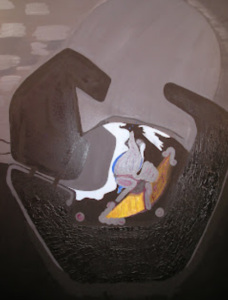
Entelechy II was my recent gift for Kristi Ann Harris. It wasn’t really her 24th birthday gift but it was close. She says it is her favorite. We have had long discussions about the use of black in my art and it is of course significant that she chose a white piece for her own. I told her black represents the existential void which idea she finds disturbing. Kristi has lately taken to the path of faith so I explained that it is on faith that the void, with an infinite subtlety, becomes full of the divine. Nonetheless unless sustained by a belief system of some sort it can shift back to everlasting emptiness yawning at our feet. All creatures must cope with this teetering on the brink of meaning and not meaning, of purpose and not purpose, of love and not love, of God and not God. It is our intention that foreshadows whether our path is into nihilism or solipsism, or deism. It is our determination that takes us into everlasting darkness of the abyss or into the redeeming light of infinite bliss which is union with the divine.

Oil on canvas.

Old Flames

I don’t think this is going to work the way I would like. Usually when I come here I have a fairly clear idea of what I want to write but today I have only the need to write. I am patient though, and will dwell here a little to see what happens. There is plenty to say but I just don’t know how to do it this time. I am not confused. I am overwhelmed. Life is so full of so many myriads of experiences and all need to be put to words. Doing so not only is an affirmation of those events it is also a validation and a way to immortality. Sort of. It is like having children and knowing with certainty that you live on in them and in those of their issue forever.

The landscape of my dilemma is vast and presents itself like a white dove fluttering in the featureless void. This is what I feel like. I pull back from the abyss, or I am pulled back by fate. Invisible strings? Fruits of intention? Answers to fervent petitions to a personal deity? I don’t know but it is certainly true that whatever your intention or petition the response when it comes will be rife with complexities unanticipated. Life is above all a kind of fractal. Recall E.E. Cummings, “Deeds can’t dream what dreams can do.” Knowing this, that discovery is the action of the unknown, vulnerability is my natural state. Risk is almost a metaphysical category in my life so I trust instinctively, and love. This is something I have long cultivated. Yet at this juncture there are no paths and I must pick my way carefully. Not that there ever were, though I imagined them. Here is a generous spirit, an incomparable beauty, and compelling desire but these are understood. Not as a measurement, not as something known, but as something intimately owned. A part of me that is a part of another, truly an apotheosis. Yet, it is an expression only begun, a running, tripping, headlong rush through the void. That plummeting, fluttering white dove suspended in darkness, no place to rest, find completion, no twig to grasp, none, nowhere. So vulnerable. So helpless.

We make our own light here in this fastness of the soul. I would shine and thus show a path for others but how to make a path through the abyss? What are the signposts? The dove? No, that is an aspect of spirit. Love? I think love is more. This is it. Love is a lot more. It is, in fact, the void itself. The abyss unrecognized. The unfathomable void. If someone asks you what you mean by love tell them that love is meaning capable of filling any emptiness whatsoever. Even if that emptiness is the whole cosmos. And with that the circle is completed and Beauty and Truth with Love shine like facets of the same jewel and their light penetrates any darkness whatsoever, any darkness anywhere. To be open to this is to share in everlasting, eternal joy and to make another see this is even greater because it is in reality the divine spark finding and kindling anew eternal fire, fire that burns everywhere and consumes everything. It is the annihilation we so earnestly desire, to be lost in the other. So, yes, I have looked into eyes and realized while I was falling, a white dove fluttering, that the darkness in the midst of our eyes was the same place, that we were one and the darkness is also the light universal, centered everywhere, bounded nowhere, an infinity to be discovered, not a mystery to be unraveled. I don’t want to know. I want to always be on the cusp of the new, discovering roads untrodden, lighting the way on an eternal journey. So, yes, I have and still do love. The words come easy. So right. So easy. “I love you.” Go tell someone in words, in deeds, even with a soulful look into their eyes, and if they ask what you mean, and that is natural, they are asking for what is said here. Choose your words carefully after a close reading of your hearts and the meaning they convey will be near the truth here expressed.